























Seven Hills is known for being the best. But it’s also known for being coddling. From the guidance and attention students and parents receive, to the gigantic magazine the school sends every year describing exactly how the school spends its money, the school seems to be angling to not only provide education, but also customer service. I believe it’s undeniable that Seven Hills pampers its students more than other schools. They deal out fewer detentions, less severe punishments, and many teachers are incredibly lenient when following rules, and we seem to have a four-day school week every other week. The question is: Is this pampering beneficial?
My stance is that, no, it is not beneficial. It is nice to have help. But help won’t always be there, and I believe that Seven Hills students develop an unhealthy reliance on their teachers. Oftentimes, I can feel a student overstepping and asking too much of a teacher, or I can feel the student being a bit too open with their confessions to teachers. I feel this is a manufactured issue, one caused by the school environment, all part of Seven Hill’s central ideology, guidance, which is prevalent on the school’s website:
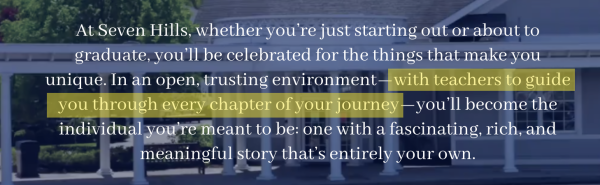
I don’t want to condemn help from teachers; help is often beneficial. But Seven Hills is so focused on guidance, to, in my opinion, the point of providing a luxury experience, that it can seem like teachers are meant to be students’ concierges more than their educators. Some students don’t even seem to try solving a problem before asking for help, in my experience, which I think is an example of educational weaponized incompetence. While this is all just my own theory, many people agree that gentle parenting, and in this case, gentle schooling, can lead to kids without independence and resilience.
But I wanted to know a teacher’s opinion on the subject. I had a conversation with Mrs. Driehaus, an APUSH teacher who has been here for 26 years. For one, she was able to predict my sentiment on the coddling, which I thought was interesting. Driehaus also said, “I think that it has been made pretty consistent,” when I asked her how Seven Hills’ treatment of students has changed. Driehaus also disagreed with my overall view on Seven Hills’ treatment of the students. While I labeled it coddling, she said, “[At Seven Hills, we are trained to think] How does this help the individual? We are less interested in standard procedure than we are in individual students. And so I could see that feel coddling or feel enabling, but I think it comes from a place of the relationship between students and teachers.”
I also asked her if she thinks that the coddling can become dangerous, if done too much. She said, “Well, I think that teachers have to have boundaries and standards. You have to be very clear about what those are. And I think that can be confusing for students because they go from class to class and teacher and teacher and expectation to expectation.” I definitely agree with this sentiment. I think that the inconsistency she is talking about is definitely prevalent, and it can be challenging for students to switch between expectations.
I also think this switching between boundaries is the source of the entitlement that is clearly here at Seven Hills. Every time I confront a student on the topic of privilege, they reply with something along the lines of, “I pay a ton of money to go here, XYZ should happen.” I find this idea damaging. Students aren’t paying the school to be your concierge– we’re paying the school to educate us.
I also asked Mrs. Driehaus what she thought about the purpose of schools, and she said, “[I think] the purpose of school is to help kids develop a sense of purpose and develop the skill sets that they’re going to need to be successful. If that is the goal, then I do think that there is a certain amount of attention that is necessary.”
I agree with this, as well. There is an amount of attention that is helpful, but too much (or too little), and it can become damaging. I think this is what the school fails to see in some cases. Some teachers seem to give a bit too much attention, while others might not give enough. It’s a balancing act, and depending on the teachers a student has, the scales can tip, and in turn, shift students’ outcomes.
Mrs. Driehaus had another interesting belief, that this attention that students receive is only possible at Seven Hills, as she said, “We have the numbers to do it.” I agree with that as well. I find we have a ton more teachers than other schools, and offer services like extra help, where other schools have a “go find the teacher” system, which isn’t always helpful if you need an answer quickly cleared up.
So what’s the answer: Are Seven Hills students coddled? I think the answer is still yes. Despite the benefits, we Seven Hills students are far more coddled in comparison to other schools’ students. And, I worry for the character and reaction skills of many students, which will likely be skills they’ll have to quickly develop after high school.
But I also think that, for most Seven Hills students, this nurturing creates a helpful environment that fosters education over all else, even if it sometimes fails. Especially after being in public school kindergarten through sixth grade, I appreciate Seven Hills’ treatment. But, I worry that other students, who were not calloused by rougher, independence-focused public school treatment, will leave Seven Hills unprepared.